Shrink the Room
Smaller also makes the hard stuff possible. Sharing a struggle from work with six people at a table is a real ask, but somebody goes first and it opens up.

Weeks after the Community-Led Growth conference, my mastermind group chat is still going. Last night I shouted out someone in the group who’d just landed a new job, and the thread blew up.
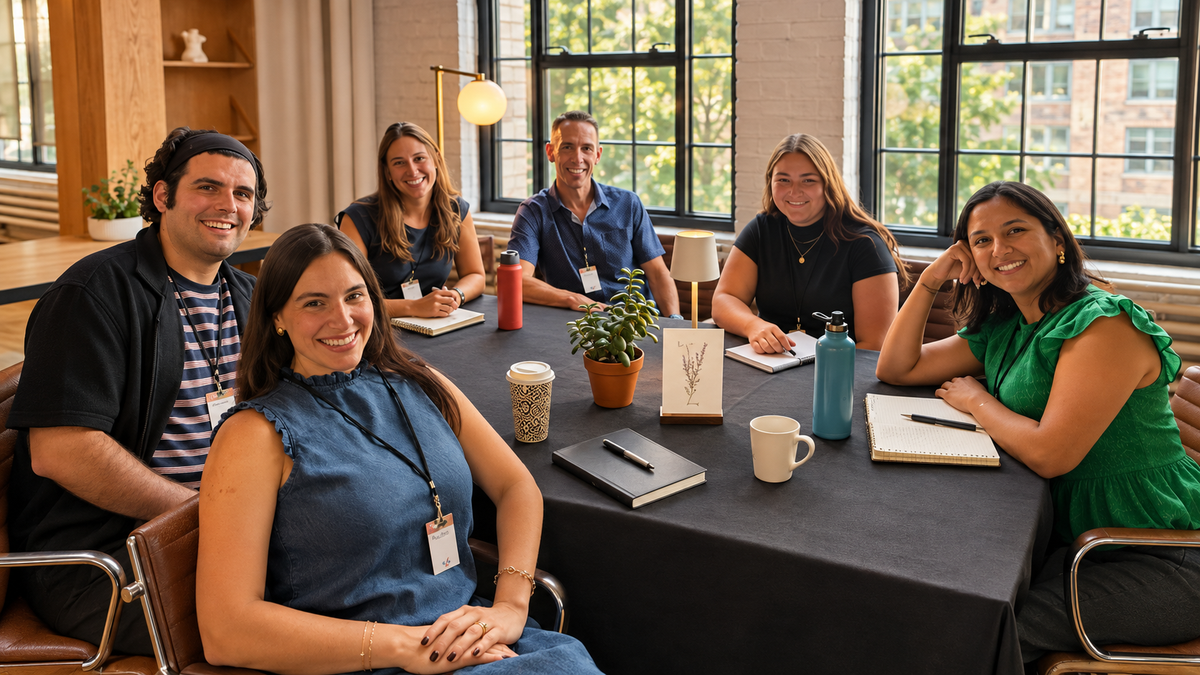
I don’t have that with anyone else from the conference. Same event, same rooms, same unreasonably good breakfast. The difference is David Nebinski. He’s a consummate networker and an all-around great guy, and he put six of us at a table in the morning programming and gave us real time together. That small group became a unit. The rest of the conference stayed a crowd.
That’s a cohort. And you can build one on purpose.
Most community builders started with a cohort without calling it one. The first handful of people who came in the door were your first members. You knew them. You knew what they wanted and could watch it change.
Then the community grows. Ten thousand members. Thirty thousand. Fifty. At that size your community is basically Liechtenstein, a small country that probably needs a couple of political parties. You stop knowing people and start making personas. Mr. Busy. Ms. Antsy. Slowly you turn into a weather reporter: engagement is trending up, activity dipped this week. The CFO across the table has no idea what that means, and neither do you.
A cohort brings it back down to a group of people you can actually get to know and work with. Even a small one is a community in its own right. You can see change. You can talk to people about what they’re trying to do, and that’s usually where the energy comes back.
Smaller also makes the hard stuff possible. Sharing a struggle from work with six people at a table is a real ask, but somebody goes first and it opens up. Doing it into a microphone in front of a full room is a completely different request, and most people will never make it. In the small group, feedback becomes possible to give and possible to receive.
There’s no magic number. Two is too small. Three is decent, but someone always ends up sitting out. We did six at CLG and it worked. The right size depends on the change you want and the topic. If people are job hunting, a pod of four or five gives them more exposure to the market. If they’re working through something uncomfortable, start smaller and build up.
The next thing a cohort does is give everyone the same job. People show up to the same product for completely different reasons. One person bought a Peloton to lose ten pounds. Another uses it to hang laundry. Somebody’s kid treats it like a jungle gym. A cohort lets you set one shared goal, say fifteen rides in five weeks. Everyone keeps their own reasons, but now they’re pulling in the same direction and can help each other get there.
That’s why cohorts are one of the rare moves where both sides win. A product community wants adoption, and the member doesn’t care about adoption. Put that member in a small group that journals twenty times over four weeks, though, and they’re reading other people’s stories and sharing their own.
It’s easier to keep going when proof is all around you. You get the adoption. They get the group. And you get a sentence you can say to the CFO. Say eighteen people start and fourteen finish. That isn’t “engagement is trending up.” It’s fourteen people who now use the product the way you hoped, and you can name every one of them.
Redesign onboarding instead, and everyone already through the door feels nothing.
A cohort doesn’t have to run for weeks, either. Sometimes it’s one great hour. A lot of digital community feels like you just missed the train. Something big happened last night, nothing is happening now, maybe you’ll catch the next one. What sustains people is a few peak moments. Maybe only twenty of your five hundred members show up to one. That’s fine. They meet four people, and now the community has friends in it.
Budget works the same way. Ten thousand dollars across a year is a little over eight hundred a month, which doesn’t buy many bagels. Four events at $2,500 each is something you can make meaningful.
Sponsors can play too. Instead of a logo on a slide, put one of their experts at a table with six people who said they care about that problem. The sponsor leaves with real conversations. The attendees leave knowing a person, not a company, and people refer people.
So pick one moment you already run. A launch, a meetup, a sponsor slot at your event. Decide the unit, give the group one job, and plan how people meet.
On that last part, have people introduce each other instead of themselves. Pair up, talk for two minutes, then introduce your partner to the room. George Mack points out that Americans are great at hyping their friends, and being introduced by someone else transfers trust fast. You also leave knowing one person well.
Somewhere in your community there are six people who’d still be texting each other a month from now. They just haven’t been seated at the same table yet.
Don't just build...SHRINK!