The Right Move at the Wrong Time
That's the first timing lesson from racing: knowing when to use pressure as a tool rather than react to it. Pogačar didn't just beat Pidcock on fitness. He read the moment and chose differently than he had before.

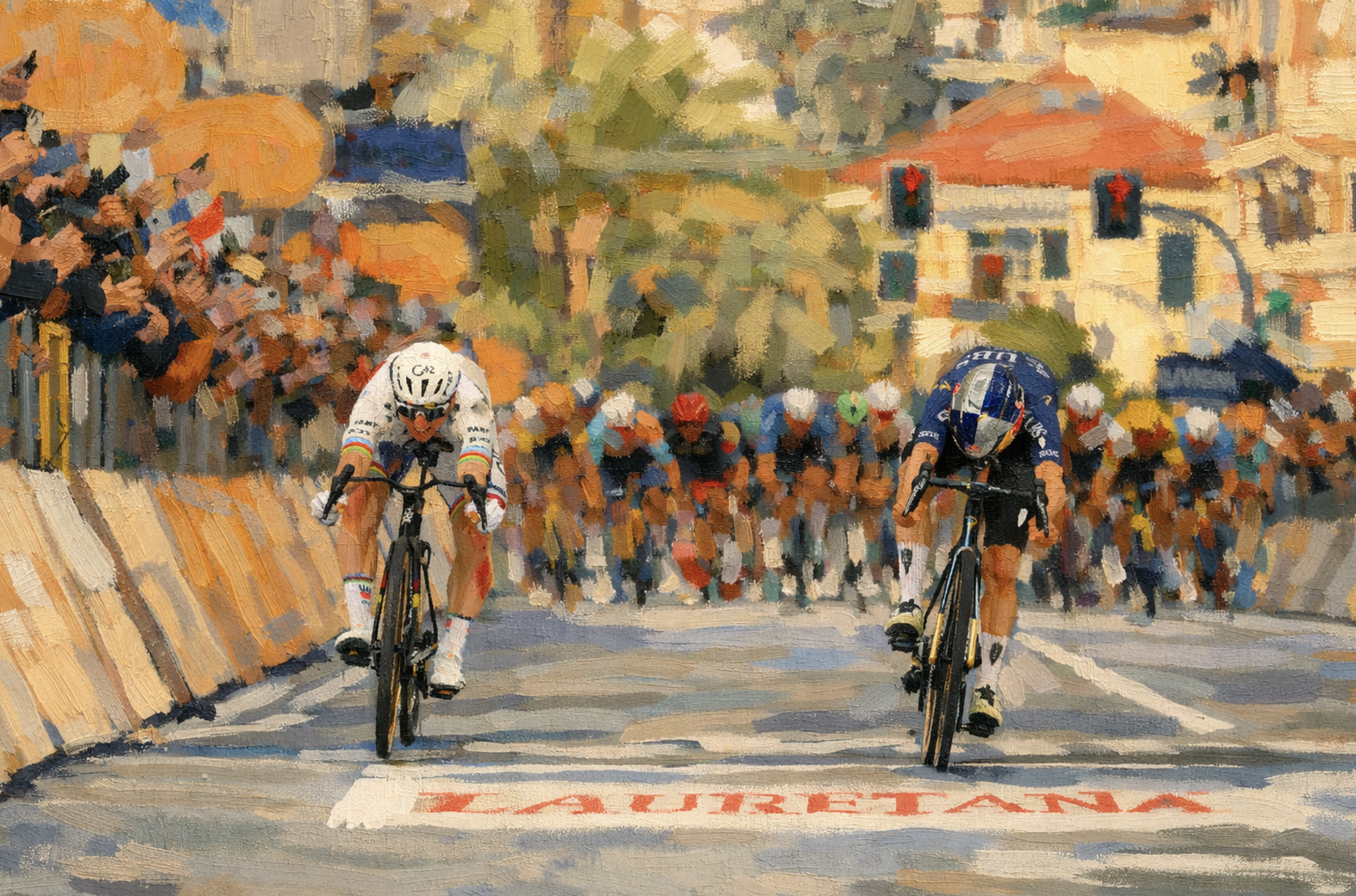
Half a wheel. Four centimeters.
That's how close Tom Pidcock came to beating Tadej Pogačar at Milano-Sanremo. Three hundred kilometers of racing. Everything executed correctly. The break. The survival. The positioning. He was right on Pogačar's wheel with 200 meters to go.
Then Pogačar launched, and Pidcock was boxed in, pinned against the barrier on the right side. He had to hesitate, slow down, drift left, and come around. By the time he was free, the race was over.
Half a wheel. After 300 kilometers.
That's not a fitness problem. It's a timing problem. And it's the most brutal kind of loss, because you did almost everything right.
What Racing Teaches About Timing
The Pogačar finish is worth slowing down on, because there's more happening than a positioning mistake.
In the final kilometers, the peloton was 7 seconds back. That gap was the decisive variable. Pogačar used it as leverage — he forced Pidcock and Van der Poel to work, spent the final kilometers conserving while they drove the pace. The previous year, he went early and rode solo. This time, he waited. Let the pressure build. Then converted it.
Same rider. Different timing. Completely different outcome.
That's the first timing lesson from racing: knowing when to use pressure as a tool rather than react to it. Pogačar didn't just beat Pidcock on fitness. He read the moment and chose differently than he had before.
The second lesson is the early break. In bike racing, the early break almost never wins. But if you're going to go, go early. You can't decide later that you wanted to go earlier. That moment is gone.
The early break works when you get forgotten — when the peloton lets you set your own pace, when something happens behind you that you're not part of. It's a gamble. A million reasons it fails. But there's one reason to go anyway: control. Even when it's brutal, you're setting the pace. You're dictating. Psychologically, physiologically, that's better than reacting.
The third lesson is the counterattack. The best time to attack is when it makes the least sense, when everyone is settling, when the group thinks the decisive move already happened. Nobody's expecting it. Which is exactly why it works.
And then there's the long-range attack. The November gym metaphor. When everyone else is resting, you start pushing. You don't look like you're doing anything special. But six months later, the gap is real. You built it in the dark, when no one was watching.
All four of these — leverage, early commitment, counterattack, long-range building — are really just different expressions of the same question: when do you go?
The Timing Paradox in Business
Here's the cruel part: being right about what to do doesn't mean being right about when to do it. And wrong timing is often indistinguishable from a bad idea.
Google Glass launched in 2013. It was a head-mounted display and camera that offered voice control, notifications, and rudimentary AR overlays. In hindsight, it looks like a prototype of everything we now know smart wearables can be. But in 2013, the market wasn't ready for a computer on your face. The value proposition was vague, the privacy backlash was immediate, and the hardware wasn't close to matching the concept. By early 2015, Google ended consumer availability and repositioned Glass into narrow enterprise niches. The idea wasn't wrong. The timing was.
Go back further: General Magic. Founded in 1990, they set out to build handheld wireless communicators — devices for messages, information, and personal digital assistance. Smartphones, in other words. Fifteen years too early. In the early 1990s there was no mobile data infrastructure, no consumer internet, and limited wireless networks. The underlying plumbing didn't exist. Magic Cap 1.0 shipped late and buggy. As mobile phones and the web took off in different directions, General Magic ran out of road and filed for bankruptcy in 2002. The vision was correct. The decade was wrong.
The Segway is the third case, and the most instructive because the hype was so enormous. Unveiled in December 2001 as "the invention that changes everything," it was going to transform urban mobility. Today we know that vision was right. It's called micromobility, and it's everywhere. Electric scooters, e-bikes, last-mile transportation. But in 2001, cities had no legal or physical infrastructure for personal electric vehicles. There were no dedicated lanes, no consistent regulations, and no mass demand for sustainable micromobility. At $4,950, it was too expensive relative to its practical benefit. It became a cultural punchline. The concept didn't fail. The ecosystem wasn't there yet.
Three companies with real insight. All three punished for arriving at the right idea in the wrong era.
Now flip it. The window closing while you were still planning.
I'm over 40 now. Almost every idea I have feels like it's already too late. Someone else is doing it. The moment has passed. I've been coaching myself out of this because while the feeling is real, it's also a trap. Waiting for the perfect moment is just procrastination with better branding.
I have a business I started — The Station — that shouldn't have worked on paper. Wrong founder for the category, non-obvious timing, uncertain market. But it worked partly because of a moment of commitment. Right place, right people, but I still had to go. Serendipity only shows up if you're moving.
The companies that went too early were trying to create their own timing. You can't do that. The companies that waited too long were mistook preparation for readiness. Those are different things.
How to Know When to Go
There's no clean formula. But there are signals.
Signal 1: Can you sustain this effort to the finish?
In racing, the biggest mistake is going so hard that you blow up before the line. The question isn't "am I strong enough to attack?" It's "am I strong enough to hold it all the way?" Duration beats explosiveness. If you can't sustain it, you're not ready — you're just impatient.
In business, this translates to: do you have the operational capacity, the team, the capital to see this through? Or are you sprint-launching into a marathon?
Signal 2: Is everyone else working too hard right now?
In the peloton, the best moments to attack are when the group is working, chasing a break, fighting crosswinds, grinding up a climb. Everyone is at their limit. That's when a fresh move can stick.
In business: is the market fatigued by a saturated approach? Is the obvious solution making everyone tired? The counterintuitive move often works because it hits when the competition has nothing left.
Signal 3: What's your actual strength?
Don't try to attack the way someone else would. Pogačar has a different finishing kick than Froome. Froome didn't sprint, he timetrialed. The early break works for different riders than the late sprint does. Know what you are and commit to doing it, not a version of what someone else does better.
In business: don't compete on someone else's turf. Double down on what you can sustain.
The commitment test.
Here's the most honest signal: if everything in you is saying go, go.
You can't decide later that you should have gone earlier. The moment is gone. The break is up the road. You can rationalize it after the fact, but you knew. You knew before you knew.
I'm coaching myself to trust that signal sooner. Because being early to something has costs. Being late almost never has upside.
The 1% That Decides Everything
You can win 99% of a race and still lose if that 1% was the decisive moment.
Pidcock did 99% right. Three hundred kilometers. The break. The survival. The positioning. And then a half-wheel gap against a barrier changed everything.
That's not a cautionary tale about trying harder. It's a lesson about what actually decides outcomes when two people are equally good.
Timing beats strength when margins are tight.
Not because strength doesn't matter — it does. It got you here. But at the highest level, where everyone is equally strong, timing is the differentiator. When do you go? Where are you positioned when the decisive moment hits? Are you boxed in, or are you already moving?
Google Glass was strong. General Magic was visionary. The Segway was technically impressive. None of that helped when the timing was wrong.
Pogačar was fit in both years at Sanremo. But the timing was different (it always is) and the outcome was different.
The question isn't whether you're ready. The question is: where are you positioned right now? Are you boxed in, or setting up for the move?
—
What's the idea you've been waiting to act on? Is it too early, or is that just what "not ready" feels like?